
Intel XR Dome
A geodesic dome I built in Petah Tikva with the local municipality and a team of Intel volunteers, turning immersive projection and interactive media into a hands-on creative space for local youth.
What is the Intel XR Dome project, exactly?
Imagine walking into a large geodesic dome, and instead of looking at a conventional screen like a TV or a computer, content wraps around you from every direction, in a full 360 degrees. That was the vision behind the XR Dome project, built in Petah Tikva in partnership with Intel, the local municipality and the local school system. The goal was to create a technological space that was interactive and immersive, one where the user isn't outside the experience but genuinely inside it. Content is projected across the dome's entire inner shell, and the environment itself responds to whoever is standing inside it.
My part in the project: what did I actually build there?
In the project's original video, I'm shown as a student, and that's genuinely what I was at the time. But in practice, my involvement wasn't just that of an end user enjoying the technology. I worked as part of the core team that developed the system itself.
From the earliest stages, I wasn't satisfied with just using a finished system. I had a real drive to understand its capabilities in depth and see what could actually be built with it. My main role was developing the experiences, the content and the different uses of the system. I had to figure out how to take a highly complex piece of technological infrastructure and turn it into a practical tool people could genuinely use for learning and creating.
The impact: what made the project so successful?
What made this project meaningful, and not just a technological gimmick, was a shift in how we thought about using it. The approach we took to developing content was that the user isn't a passive viewer, they're an active part of the experience.
For example, we realized this tool could completely change how students learn. Instead of learning about processes or places through text, the dome let us illustrate things in space. But the real value came when we decided to let students develop content themselves. When someone builds an experience for someone else, they have to genuinely understand the material and plan how the user will move through the space. That decision turned the process of creating the experience into part of the learning itself.
We managed to create powerful experiences in other worlds too, like sport. When we built an experience based on skeleton, the high speed sport of sliding down an ice track, being able to surround the user's entire field of view created a sense of motion and speed that no regular screen could deliver. That connection between the technology and a genuinely human experience is what made the difference and made the project succeed.
Behind the scenes: the technical side of the experience
For that magic to actually work, we had to solve quite a few technical challenges. A regular screen has clear edges. Inside the XR Dome, that edge disappears. The development work meant thinking about the user's spatial field of view, their sightlines, and how different elements would appear and move around them.
On the hardware side, the system relied on a complex combination of cameras, sensors and computing systems built to capture what was happening inside the dome. Every movement, position or action from the user became input we processed in real time, and in response, the projected content changed.
The biggest challenge in development was connecting all these different layers. The computer, the graphics processing, the surrounding projection and the sensors all had to speak the same language and work together in perfect sync, so the user would experience one smooth, unified space.
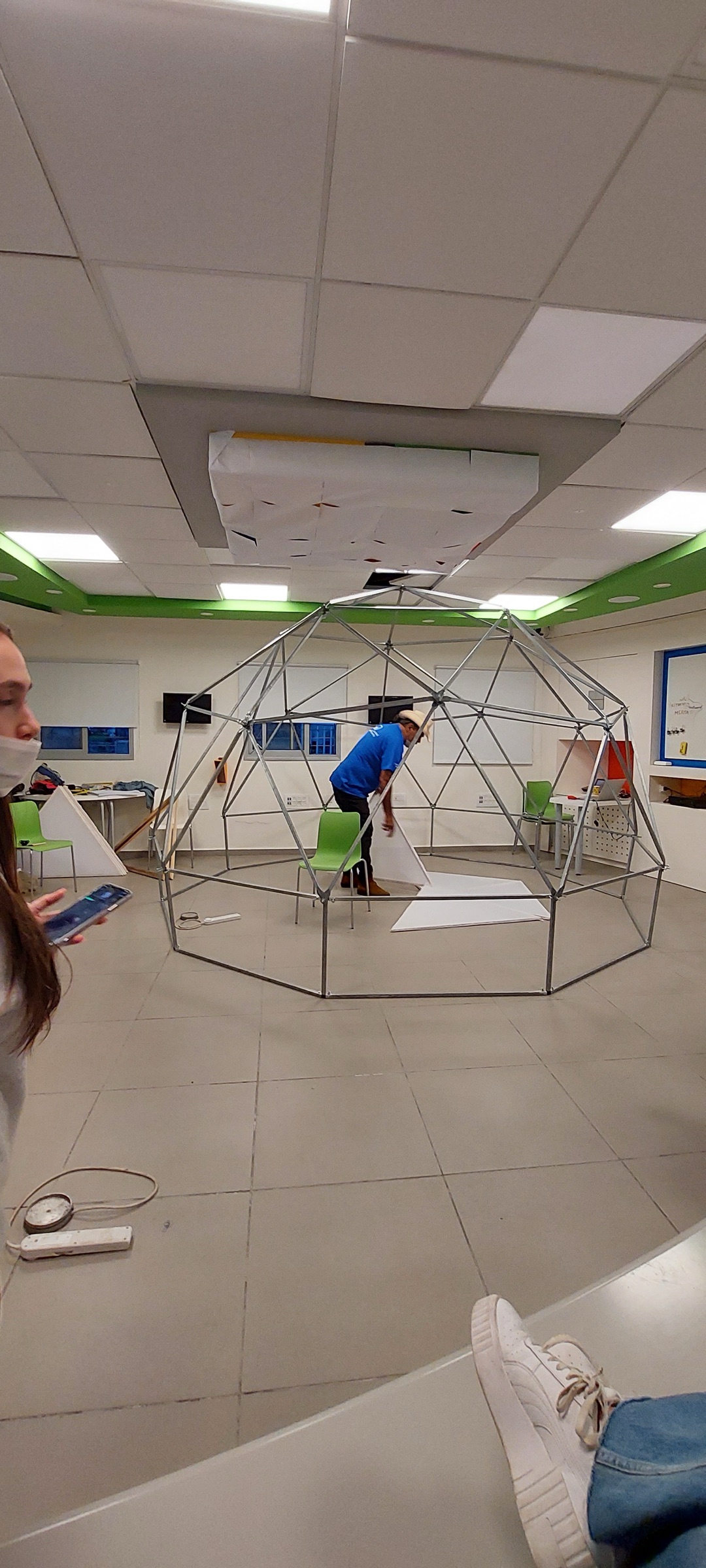
By the way, that complexity started even earlier, at the physical stage, when we built the dome's own frame, panel by panel, together with Intel volunteers, before we turned it into a working machine.
Where this leads
When I look today at the work I do building websites, platforms and AI systems, I'm still working by the same principles that were born back there, inside the dome. I learned that technology, however advanced, is just a tool. The real challenge, and the thing that genuinely interests me, is understanding how to take a system apart, see how its pieces connect, and build something that gives real value and a real experience to the people using it.